Exactly 23 years ago, we opened our first server room, which was designed for both rack and tower servers. Does it make sense to continue? We think absolutely yes. And that's why we keep investing in tower colocation.
Tower Servers and History
In 2003, there were only a few data centers in the Czech Republic, and virtually all of them accepted servers in rack servers only. Tower and PC servers were simply turned away or accepted at disproportionately high prices. At the same time, a rack server with the same configuration cost roughly twice as much as its tower counterpart. The upfront hardware costs for having a server in a data center were simply too high, and colocation remained the privilege of a top group of companies and IT specialists.
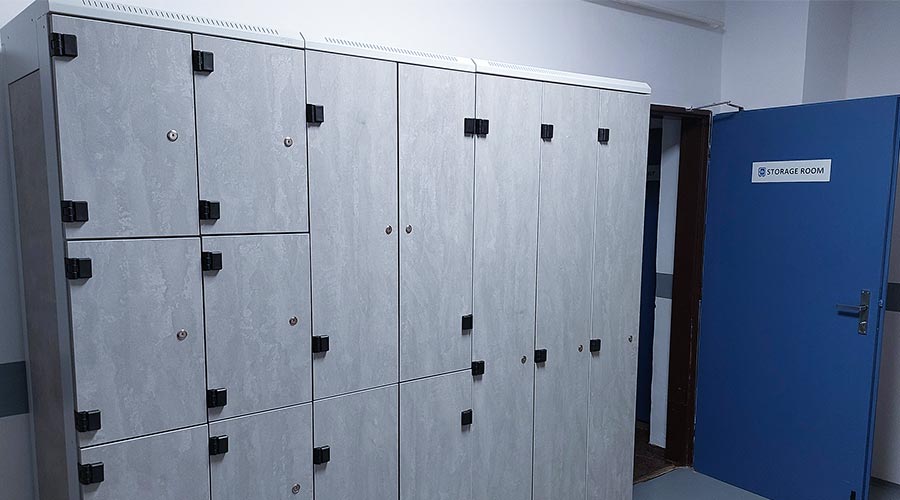
That is exactly what led us to take a different approach in the spring of 2003. Alongside shared racks, we offered shelf space for tower servers at accessible prices from the very beginning, because we wanted this service to be available to the broader IT community, not just a select few.
One year later we introduced size-based categorization: small, midi and big, based on the physical dimensions of the chassis, and in 2012 we added real power consumption metering starting from 50 W. Since then, every client pays exactly for what they actually use and drain. We stand by this principle to this day.

Example of our advertisement in 2016.
Advantages of Tower Servers
The price difference between tower and rack servers has narrowed significantly in recent years. So why still bet on tower? Because price is only one part of the equation.
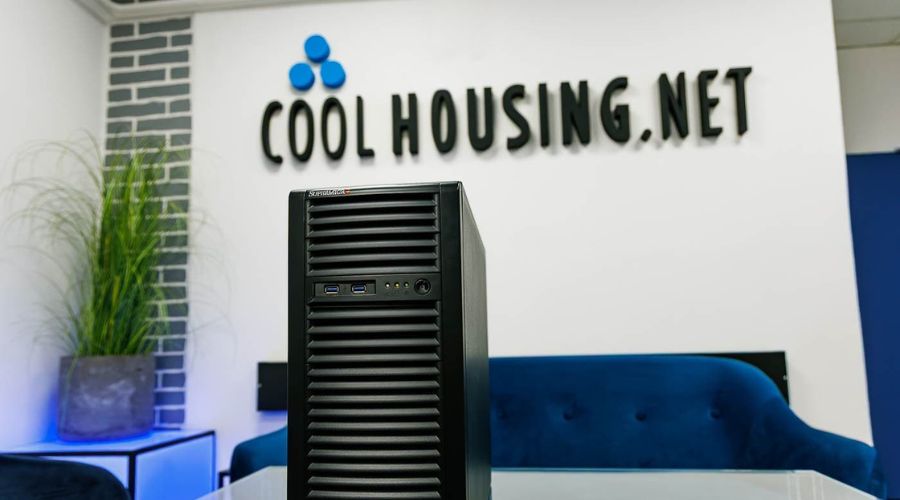
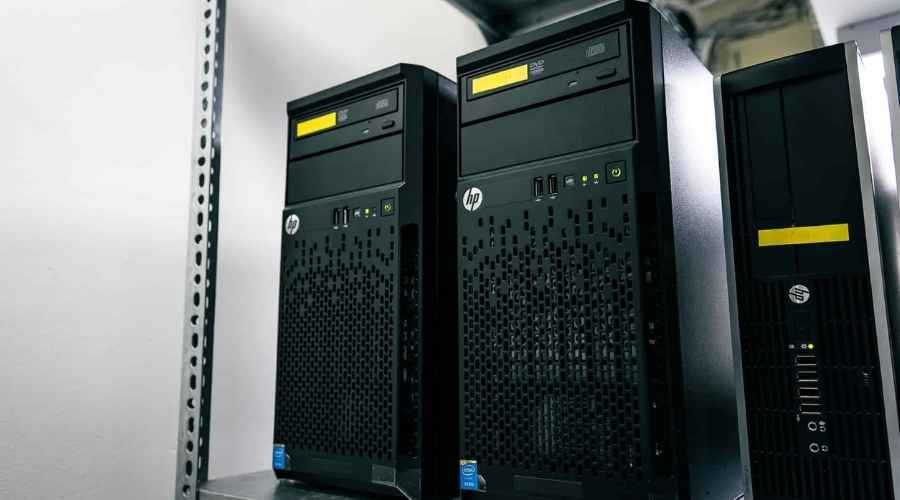
Rack servers have gained popularity thanks to their compact dimensions and space efficiency. However, this form factor comes with a trade-off, most notably in cooling performance. Over more than 20 years, we have conducted dozens of stress tests in which we configured both tower and 1U rack servers with identical hardware. In a 1U chassis, cooling a processor with a TDP of 130 W requires pushing air through an opening of just 44.5 mm × 482 mm, which demands powerful fans, and usually more than one. A tower case, on the other hand, can accommodate fewer but larger fans running at much lower speeds. In every one of our tests, the tower came out ahead, and in extreme cases, the difference in power draw exceeded 100 W.
The spacious chassis also provides room for more drives, expansion cards and higher-performance components, all accessible without any special tools. Replacing a drive, memory module, or power supply takes just a few minutes. Add to that the elimination of costs for rack rails and accessories, and the tower server becomes a highly compelling choice, particularly for those looking to maximize performance at a sensible cost.
The Future of Tower Colocation
Tower Colocation at Coolhousing is not going away, quite the opposite. Whether it comes to cooling efficiency, ease of maintenance, or the ability to accommodate non-standard or repurposed hardware, we are firmly convinced that this service has an irreplaceable place in our data center for years to come. One of many proofs is our expansion of colocation options to include NAS, NUC and mini PC units, as well as the complete replacement of one of our central UPS systems, which also powers the tower server section. Thanks to this modernization, this type of server will be able to run in our data center reliably for many years ahead.
Coolhousing Team